

Lisbon’s short-term rental containment zones determine whether a new property registration is possible at a given address — and, if so, under what conditions. The new Lisbon Municipal Short-Term Rental Regulation (RMAL), approved by the Municipal Assembly on 2 December 2025 and published in the Diário da República as Aviso n.º 29926-A/2025/2, introduced a containment system operating at three distinct scales: municipal, parish, and neighbourhood. An April 2026 reclassification — following the cancellation of 6,765 registrations for failure to submit updated insurance proof — changed the status of several parishes and removed Avenidas Novas from any containment regime.
This guide explains how the system works, which zones are currently under containment, and what each level means in practice.
How Lisbon’s containment system works
The containment classification is based on the ratio between the number of short-term rental establishments registered in the national registry (RNAL) and the number of permanent housing units recorded in the most recent Census published by INE (Statistics Portugal). The Lisbon City Council’s (CML) Monitoring Division recalculates the ratios monthly and applies them at three scales:
- Municipal level: if the ratio for the entire city of Lisbon reaches or exceeds 10%, the whole municipality enters absolute containment. The current municipal ratio is approximately 7.0% (November 2025 data), so this threshold has not yet been triggered.
- Parish level: each of Lisbon’s 24 parishes is monitored individually. A ratio at or above 10% places the parish in absolute containment; between 5% and 10%, in relative containment.
- Neighbourhood level: individual neighbourhoods (bairros) within each parish are also monitored. A neighbourhood can be in containment even if its parish is not — provided the neighbourhood ratio exceeds the relevant threshold and the parish is not already classified as containment (absolute or relative).
The two types of containment
Absolute containment (ratio at or above 10%)
In absolute containment zones, new short-term rental registrations are prohibited, except in the narrow exceptions defined by the regulation. These zones also apply a transmission restriction: in the apartment and house modalities, the transfer of a short-term rental registration — for instance, by property sale — causes automatic expiry of the registration number. The incoming owner cannot inherit the RNAL number and must apply for a new registration under the rules applicable at that time.
The circumstances in which the CML may exceptionally authorise new registrations in absolute containment are:
- Comprehensive rehabilitation of derelict or ruined buildings that have been vacant for more than three years
- Projects considered of special interest to the city (mixed-use developments with an affordable housing component)
Exceptional authorisations in absolute containment are granted for five years, non-renewable while the containment classification remains in place.
Relative containment (ratio between 5% and 10%)
In relative containment zones, new registrations are possible but require express authorisation from the CML. The application is submitted to the municipal services and the CML has 90 days to decide. As an alternative first step, applicants can request a prior binding opinion (pedido de informação prévia) — the CML responds within 30 days and a favourable answer is binding for two years.
In relative containment, in addition to the urban rehabilitation exception, there is also the option to register in the “room” modality (modalidade quarto) in apartments of T2 or larger that serve as the licence holder’s permanent residence:
- T2 apartment: maximum of 1 room
- T3 or larger: maximum of 2 rooms
Authorisations for the room modality are granted for one year, renewable annually as long as the conditions are maintained (permanent residence, fiscal domicile at the address, room count within limits).
Current containment zones in Lisbon (July 2026)
Following the April 2026 reclassification — which followed the conclusion of the cancelled registrations process in February 2026 — the current parish-level containment status is as follows:
| Parish | AL/Housing Ratio | Current Classification |
|---|---|---|
| Santa Maria Maior | 66.9% | Absolute containment |
| Misericórdia | 43.8% | Absolute containment |
| Santo António | 25.1% | Absolute containment |
| São Vicente | ~16% | Relative containment (reclassified April 2026) |
| Arroios | ~13.5% | Relative containment (reclassified April 2026) |
| Estrela | ~10.8% | Relative containment (reclassified April 2026) |
| Avenidas Novas | ~6.6% | No containment (exited April 2026) |
| All other parishes | < 5% | No containment (growth areas) |
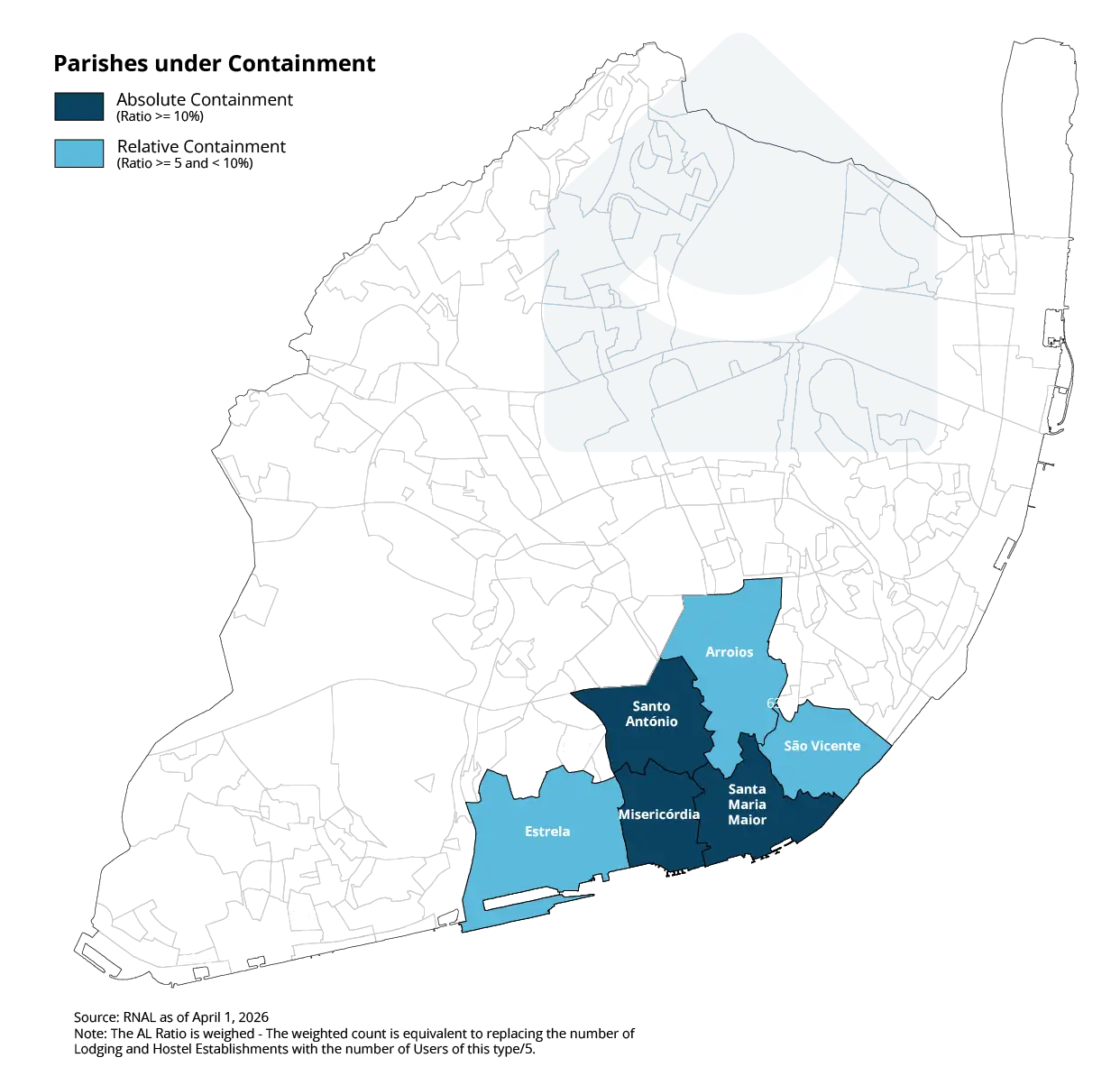
Important: the CML recalculates ratios monthly. The table above reflects the April 2026 reclassification but may have been updated since. To confirm the current status of a specific address, submit a prior information request (pedido de informação prévia) to the CML under Art. 7, para. 11 of the RMAL — the CML responds within 30 days and a favourable answer is binding for two years.
Why the containment zones changed in April 2026
In February 2026, the CML completed the cancellation of 6,765 short-term rental registrations. The main cause: licence holders had not submitted updated insurance proof via gov.pt, an obligation in force since March 2025. The cancellation reduced the number of active RNAL registrations in several parishes, changing the ratios used to determine containment status.
The April 2026 reclassification reflected these lower ratios: São Vicente, Arroios, and Estrela — which had all been in absolute containment — were reclassified to relative containment. Avenidas Novas, previously in relative containment, exited the containment regime entirely. For property owners in these areas, this represents a meaningful change: options that were previously closed are now available, at least subject to CML authorisation or within the room modality.
Neighbourhood-level containment within other parishes
Beyond the 6 parishes classified at parish level, the regulation identifies specific neighbourhoods (bairros) within other parishes that are also under containment, based on their individual ratios. The CML monitors neighbourhoods using the same criteria applied to parishes. A neighbourhood can only have its own containment classification if its parish is not already subject to a parish-level containment order — in that case, the parish classification prevails.
Note (April 2026): following the April reclassification, 7 neighbourhoods exited relative containment and 5 moved from absolute to relative. The tables below reflect the original regulation composition (November 2025). The updated neighbourhood list is pending official CML publication in the Boletim Municipal.
Neighbourhoods in absolute containment (November 2025 composition — partial)
The regulation identifies 22 neighbourhoods in absolute containment. Those listed below appear in the regulation text; the remainder are shown only in the map in Figure 3 of Aviso n.º 29926-A/2025/2.
| ID | Neighbourhood | Parish |
|---|---|---|
| 5808 | Bom Sucesso | Belém |
| 5807 | Belém | Belém |
| 5801 | Ajuda | Belém |
| 201 | Alcântara | Alcântara |
| 5908 | São Bento | Campo de Ourique |
| 5708 | Picoas | Avenidas Novas |
| 5709 | São Sebastião da Pedreira | Avenidas Novas |
| 6310 | Sapadores | Penha de França |
| 6205 | Parque das Nações – Centro | Parque das Nações |
Neighbourhoods in relative containment (November 2025 composition)
The regulation identifies 11 neighbourhoods in relative containment (CML authorisation required; room modality permitted):
| ID | Neighbourhood | Parish |
|---|---|---|
| 5809 | Junqueira | Belém |
| 5805 | Bairro Novo da Memória | Belém |
| 107 | Bairro Novo da Memória | Ajuda |
| 101 | Ajuda | Ajuda |
| 206 | Junqueira | Alcântara |
| 204 | Bairro do Calvário | Alcântara |
| 5904 | Estrela | Campo de Ourique |
| 5907 | Santa Isabel | Campo de Ourique |
| 6302 | Arroios | Penha de França |
| 703 | Beato | Beato |
| 2116 | Marvila | Marvila |
| 6202 | Cabo Ruivo | Parque das Nações |
| 6201 | Bairro dos Retornados | Parque das Nações |
The transmission rule: a critical point for buyers
In containment areas, the transfer of a short-term rental registration in the house or apartment modalities causes automatic expiry of the registration number (Art. 4, paragraph 4 of the RMAL). This means that purchasing a property with an active short-term rental registration in a containment zone does not transfer the RNAL number to the new owner. The buyer must apply for a new registration — which, in an absolute containment zone, is nearly impossible without one of the narrow exceptions.
For anyone considering the purchase of a property in Lisbon with the intention of operating a short-term rental, verifying the containment zone status is as important as confirming that the RNAL registration is active.
Suspending short-term rental activity for residential letting
The RMAL includes a suspension mechanism for licence holders in containment areas. An operator can suspend short-term rental activity for up to five years in order to use the property for residential letting, by simply notifying the CML and providing a copy of the rental contract. The RNAL number is preserved during the suspension period.
When the operator requests reinstatement of the registration, the CML recalculates the current ratio. If the zone is still under containment at that point, the reinstatement request enters a waiting list in order of receipt.
How to check if your property is in a containment zone
- Identify the parish — check the parish table above. If your parish is not listed, it is not in containment at parish level.
- Check the neighbourhood — even if the parish is not in containment, the neighbourhood may be. Consult the neighbourhood tables above or the text of Aviso n.º 29926-A/2025/2 published in the Diário da República.
- Submit a prior information request to the CML — for an official, binding confirmation of your address’s classification, file a request under Art. 7, para. 11 of the RMAL. The CML responds within 30 days and a favourable answer is binding for two years.
- Monitor the Boletim Municipal — containment zone changes are published in the Lisbon Municipal Bulletin within 10 days of each CML resolution.
For the full process of registering a short-term rental in Lisbon — including documentation requirements, timelines, and how the registration process differs by zone — see our guide on the Lisbon short-term rental regulation and licence.
What you need to know
- Absolute containment: new registrations prohibited — exceptions for urban rehabilitation only (5-year authorisation); currently: Santa Maria Maior, Misericórdia, Santo António
- Relative containment: new registrations require express CML authorisation (90-day decision); room modality permitted in own residence; currently: Arroios, Estrela, São Vicente (post-April 2026)
- Transmission: in containment zones, sale of the property extinguishes the short-term rental registration automatically (apartment and house modalities)
- Three scales: containment applies at municipal, parish, and neighbourhood level — check all three for any specific address
- Monthly updates: ratios and classifications are updated monthly by the CML; changes published in the Boletim Municipal; for binding confirmation of a specific address, submit a prior information request to the CML
- Suspension: active operators in containment zones can suspend the short-term rental for up to 5 years for residential letting, preserving the registration number

Frequently Asked Questions
Following the April 2026 reclassification: absolute containment (new registrations prohibited) applies to Santa Maria Maior, Misericórdia, and Santo António. Relative containment (CML authorisation required) applies to Arroios, Estrela, and São Vicente. Avenidas Novas exited containment entirely. Individual neighbourhoods within other parishes may also be under containment — for binding confirmation of a specific address, submit a prior information request to the CML (30-day response, binding for 2 years).
In an absolute containment zone, new short-term rental registrations are prohibited, with very limited exceptions: urban rehabilitation of buildings that have been derelict for more than three years, or projects of special city interest with an affordable housing component. Exceptional authorisations last five years and are non-renewable while the containment classification holds. Additionally, selling a property in absolute containment extinguishes the existing short-term rental registration.
Yes, but it requires express authorisation from the Lisbon City Council (CML). The application is submitted to the municipal services and the CML has 90 days to decide. In relative containment, it is also possible to register in the ‘room’ modality (modalidade quarto) in a T2 or larger apartment that is your permanent residence, without needing prior authorisation — maximum 1 room in a T2, 2 rooms in larger apartments. Room modality authorisations are annual and renewable.
In February 2026, Lisbon City Council completed the cancellation of 6,765 short-term rental registrations whose licence holders had not submitted updated insurance proof via gov.pt — a requirement in force since March 2025. This reduced the number of active registrations in several parishes, changing the ratios used to classify containment zones. Arroios, Estrela, and São Vicente moved from absolute to relative containment; Avenidas Novas exited containment entirely.
No. The Lisbon RMAL establishes that in containment areas, the transfer of a short-term rental registration in the apartment or house modalities causes automatic expiry of the registration number. The buyer cannot inherit the RNAL number and must apply for a new registration under the rules applicable at the time — which in absolute containment zones is nearly impossible without one of the defined exceptions.
Start by checking whether your parish is in the containment table above (Santa Maria Maior, Misericórdia, Santo António in absolute; Arroios, Estrela, São Vicente in relative after April 2026). If not, check whether your neighbourhood is listed — individual neighbourhoods can be in containment even when the parish is not. For legal certainty before committing to a purchase or registration, submit a prior information request (pedido de informação prévia) to the CML — response within 30 days; a favourable answer is binding for two years.